

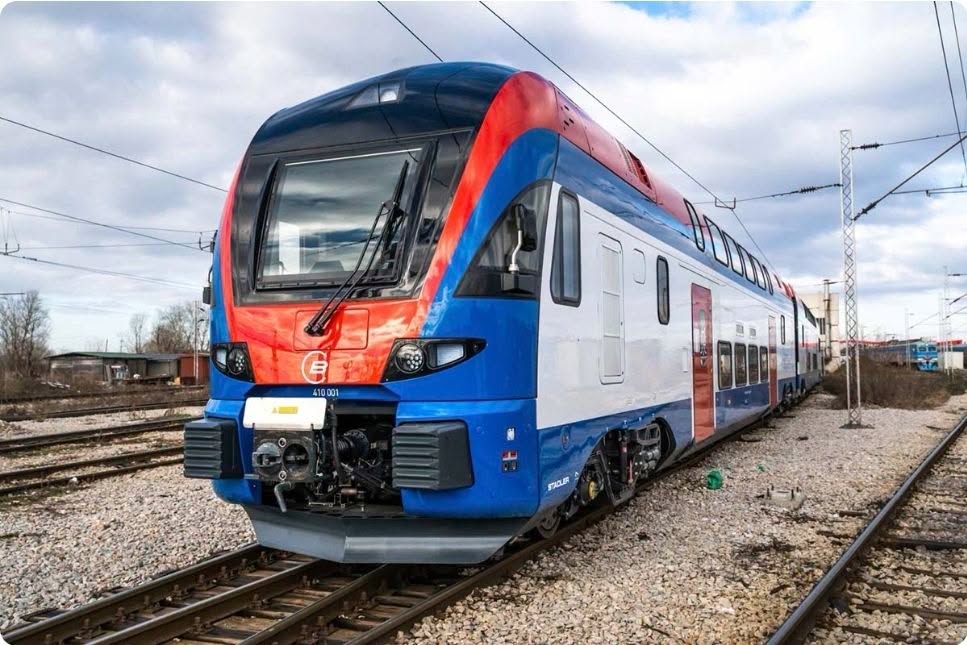
First new Škoda train for Bulgaria unveiled at Sofia Central Railway Station
 Bulgaria
23.03.2026
Bulgaria
23.03.2026
On 20 March 2026, the first new Škoda train for Bulgaria was officially unveiled at Sofia Central Railway Station by caretaker Minister of Transport and Communications Korman Ismailov. The project for the delivery of 25 multiple-unit trains is valued at EUR 326.7 million, of which EUR 261.4 million is financed under Bulgaria’s National Recovery and Resilience Plan, while the remaining EUR 65.3 million comes from the Transport Connectivity Programme 2021–2027.
The event was attended by Czech Ambassador Miroslav Toman, Škoda Group CEO Petr Novotný, and Škoda Bulgaria sales manager Olesya Lachi. According to the Bulgarian side, the new trains meet modern European standards of efficiency, safety, speed, and passenger comfort. Each unit offers 333 seats, can reach speeds of up to 160 km/h, and is intended primarily for suburban services.
The trains provide a range of modern passenger amenities, including information systems, wireless internet, power outlets and USB ports, video surveillance, accessibility features for persons with reduced mobility, and dedicated spaces for bicycles and strollers. The first two units arrived in Bulgaria in early March, while the remaining deliveries will continue in stages over the coming months. After certification is completed, the trains are expected to enter service on key suburban lines, with testing on Bulgarian infrastructure beginning in the week of 23 March 2026.
Ambassador Miroslav Toman described the arrival of the first two trains from the Škoda plant in the Czech Republic as an important milestone in Bulgarian-Czech cooperation. He emphasized that the contract includes not only delivery, but also 15 years of maintenance and repair, as well as training for drivers and technical personnel. Petr Novotný noted that the new train symbolizes cooperation between Bulgaria and the Czech Republic and is the result of around 14 months of intensive project work. He added that the trains are based on the proven RegioPanter platform, already used by millions of passengers in several European countries.
IDR comment
Experts of the Institute of Danube Research (IDR) note that the arrival of the new Škoda trains in Bulgaria is more than a national transport modernization step. It reflects a broader regional trend toward upgrading rail mobility in the Danube-Balkan space through EU-backed financing, long-term service arrangements, and more sustainable suburban transport solutions. The Bulgarian case shows how rolling stock renewal can improve not only passenger comfort, but also institutional resilience and the operational reliability of public transport systems.
From IDR’s perspective, this project is also relevant for Ukraine, because it highlights the strategic importance of modern suburban and regional rail in strengthening economic connectivity, labor mobility, and alignment with European transport standards. In this sense, Bulgaria’s cooperation with Škoda demonstrates how EU resources can support not only infrastructure renewal, but also a wider transformation of regional mobility models.

 Moldova
 Ukraine
 Serbia

 Hungary
 Romania





 Danube